

Survey Report Analysis
Wills as A Method of Wealth Management
For the purpose of our Information on Service Learning Malaysia - University for Society (SULAM), our firm conducted a brief survey regarding the awareness of UiTM Perlis society pertaining to the Law of Succession in Malaysia. Our research’s main focus is on the execution of Wills (Wasiyyah) as a method of wealth management in Malaysia. In accordance with our online survey, we collected a total of 40 respondents from Universiti Teknologi Mara (UiTM) Perlis, Arau Campus. The aim of the questions contained in this survey were to identify the scope and target participants of our firm's SULAM. The following shows the summary and analysis of the data that have been collected by our team.

The first section (Section A) of the survey conducted was intended to collect data on the personal information of the respondents. The data collected include the gender, age range, race, religion, occupation, and marital status of the respondents.
Section A
1) Gender
The first data collected upon the respondent’s personal information is the gender of the respondents. The data collected can be seen in Figure 1 as shown below.

Figure 1
Referring to the chart in Figure 1, the number of female respondents (72.5%) exceeded the total number of male respondents (27.5%). Although there was a more significant number of female respondents, it can be seen that there were respondents from both genders that had answered our survey.
2) Age
The second data collected upon the respondent’s personal information is the age range of the respondents. The result of the data collected in this aspect can be seen in Figure 2 as shown below.

Figure 2
According to Figure 2, the age range of the respondents that we managed to acquire from the society at UiTM Perlis is mostly between the ages of 18-25 years old (95%) . The majority respondents from this age range had already been expected since the location consists of university students. However, we did get two (2) respondents from other age groups namely one respondent each from the age range of 26-35 years old (2.5%) and 36-55 years old (2.5%).
3) Race
The third data collected regarding the respondent’s personal information is the race of the respondents. The data collected can be seen in Figure 3 as shown below

Figure 3
The bar chart in Figure 3 shows that the majority of respondents were Malays with a total of 27 respondents (67.5%). Next, the second most number of respondents were Chinese with a total of 12 respondents (30%). Additionally, there was one (1) Sabah Bumiputera respondent (2.5%). Finally, there were no Indian respondents who had filled in the survey.
4) Religion
The fourth data that we collected in the survey regarding the respondents personal information included the religion of the respondents. The results of the data collected can be seen in Figure 4 as shown below.

Figure 4
Referring to the data shown above in Figure 4, the number of respondents from the religion of Islam was most with a total of 27 respondents (67.5%). Next to that, there was a total of 11 respondents professing the religion of Buddhism (27.5%). There were also only two (2) respondents who professes the religion of Christianity (5%). Lastly, there were no respondents that professes the religion of Hinduism that responded to our survey.
5) Occupation
The fifth data that we collected in the survey regarding the personal information of the respondents is the occupation of the respondents. The results of the data collected in this aspect can be seen as shown below in Figure 5.

Figure 5
In analysing the results of the data collected in Figure 5 regarding the occupation of the respondents, students were the majority of society that participated in the survey (92.5%). However, we did manage to achieve a certain diversity among the respondents. There was at least one (1) respondent from the occupational group of lecturers (2.5%), inspector (2.5%) and also a paralegal (2.5%) . However, no staff of UiTM Perlis had participated in the survey.
6) Marital Status
The sixth personal information data that we collected from the respondents was their marital status. The results of the data collected can be seen in Figure 6 as shown below.

Figure 6
Accordingly, as can be seen in the chart provided in Figure 6, only one (1) of the total respondents were married (2.5%). The remaining 39 total of respondents of the survey were single (97.5%).
This second section (Section B) of the survey was intended to obtain the respondents general knowledge on the law of succession. There are only three questions contained in this section.
Section B
1) Have you ever participated in managing the estate of a deceased (person who passed away)?
The first question was intended to identify whether the respondents had any experience in dealing with any issues pertaining to the law of succession. With this, the data collected from the respondents can be seen in Figure 7 as shown below.

Figure 7
According to the survey, Figure 7 shows that most respondents (62.5%) had no experience in the management of a deceased estate. However, a significant number of participants (37.5%) had actual experience in managing the estate of a deceased.
2) Do you think it is important to learn about the laws of succession?
The second question was aimed at identifying whether the respondents believed that obtaining knowledge upon the laws of succession would benefit them or the general public. Thus, the survey results of the question posed can be seen in Figure 8 as shown below.

Figure 8
In referring to the survey results as stated in Figure 8, 95% of respondents (38 respondents) believed that it is important to learn about the laws of succession. However, 5% of the respondents (2 respondents) were not sure as to whether or not such knowledge is important to know.
3) Are you interested to learn about Wills (Wasiyyah)?
The third question in this section was intended to identify the respondents interest towards Wills. This is important as the topic of Wills (Wasiyyah) is the main focus topic of our firm's SULAM. The result of the question posed can be seen in Figure 9 as shown below.

Figure 9
The results from the survey shown in Figure 9 states that most respondents (55%) were interested in learning about Wills (Wassiyyah). However, a significant amount of respondents (40%) were not sure as to their interest in learning about the subject matter. Lastly, two (2) respondents were not interested in learning about Wills (Wassiyyah).

In this section, the purpose of the questions posed were to further identify the target participants understanding of Wills (Wassiyyah) which is the main focus of our firms SULAM project. There were seven (7) questions posed in this section and the analysis of the which are provided below.
Section C
1) Do you know what a Will (Wasiyyah) is?
The first question was posed in the survey to identify whether the respondents had at least basic knowledge of what a Will (Wassiyyah) is. The results of the data collected from the question can be seen in Figure 10 as shown below.

Figure 10
In analysing the survey results as provided in Figure 10, it can be seen that most of the participants (52.5%) knew what a Will (Wasiyyah) is. 11 respondents (27.5%) did not know what a Will (Wasiyyah) is. Lastly, 8 respondents (20%) of respondents were not sure whether they knew what a Will (Wasiyyah) is.
2) Do you know who can make a Will (Wasiyyah)?
The second question was posed as to identify whether the respondents knew who could make a Will (Wasiyyah). This question directly relates to the first question posed in this section. Additionally, this question is also important to understand whether the respondents who knew what a Will (Wasiyyah) was also knew who could make one. The results of the survey question posed can be seen in Figure 11 as provided below.

Figure 11
Figure 11 shows that 47.5% of respondents (19 respondents) knew who could make a Will (Wasiyyah) while 32.5% of the respondents (13 respondents) did not know who could make a Will (Wasiyyah). 20% of the respondents (11) respondents were not sure as to whether they knew who can make a will. It is interesting to note that the number of respondents that knew who can make a Will (Wasiyyah) is less than the number of respondents who knew what a Will (Wasiyyah) is.
3) Do you know the requirements of a valid Will (Wasiyyah) according to the law of Succession?
In accordance with this question posed in Section C of the survey, we intended to understand whether the respondents knew upon the law of succession regarding the formation of a valid Will (Wasiyyah). The data results of the question can be seen in Figure 12 as shown below.

Figure 12
Interestingly in this section, the majority of participant did not have knowledge upon the legal requirements of a valid Will (Wasiyyah). According to Figure 12, 26 respondents (65%) did not have knowledge upon the legal requirements of a valid Will (Wasiyyah), 7 respondents did have such knowledge (17.5%), and 7 respondents also were unsure of whether they knew the legal requirements of a valid Will (Wasiyyah).
4) Do you need witnesses to make a Will (Wasiyyah)?
In accordance with the fourth question posed in this section, our firm aimed to identify whether the respondents knew that a witness needs to be present when making a Will (Wasiyyah). The results of the data collected from the question posed can be seen in Figure 13 as shown below.

Figure 13
In accordance with the results of the data collected as can be seen from Figure 13, the majority of respondents which is 52.5% (21 respondents) knew that in order to make a Will (Wasiyyah) witnesses must be present. Only 3 respondents (7.5%) were sure that a Will (Wasiyyah) did not need witnesses to be present and 16 respondents (40%) were unsure as to the requirements of witnesses when making a Will (Wasiyyah).
5) Do you know when a Will (Wasiyyah) can take effect?
The objective of the fifth question was to identify the respondents knowledge on the time a Will (Wasiyyah) would take effect. The results of the data collected from the question aforementioned can be seen in Figure 14 as shown below.

Figure 14
In referring to the chart provided in Figure 14, most respondents correctly choose the answer for the above-mentioned question. 27 respondents (67.5%) answered that the Will (Wasiyyah) would take effect after the death of the testator. 2 respondents (8%) answered incorrectly as in the Will (Wasiyyah) would take effect before the death of the testator. However, 11 respondents (27.5%) were not sure as to when a Will (Wasiyyah) takes effect.
6) Who can receive property from a Will (Wasiyyah) for Muslims?
The intention of the sixth posed question is to firstly bring to the attention of the respondents that the method for Will (Wasiyyah) for Muslims and Non-Muslims are different. Hence, the second objective of the question is to identify whether the respondents knew the potential beneficiaries that could receive property from a Will (Wasiyyah) for Muslims. The results from the data collected can be seen in Figure 15 as shown below.

Figure 15
From the results of the data collected as seen in Figure 15, only six respondents (15%) of respondents answered the question correctly with their answer being anyone except family and anyone except waris/legal heirs. The remaining 77.5% of respondents answered the question incorrectly with most respondents (60%) who answered that the group of people who can receive property from a Will (Wasiyyah) is the family members only and 7 respondents (12.5%) answering that anyone at all can receive property from a Will (Wasiyyah). Only 3 respondents (7.5%) did not know or were not sure of the answer to the posed question.
7) Who can receive property from a Will (Wasiyyah) for Non-Muslims?
The objective of the seventh question is similar to that of the sixth question in this section. The aim of this question is to identify the respondents' knowledge of the potential beneficiaries for Wills (Wasiyyah) created by Non-Muslims. The results of the data collected from the posed question can be seen in Figure 16 as shown below.
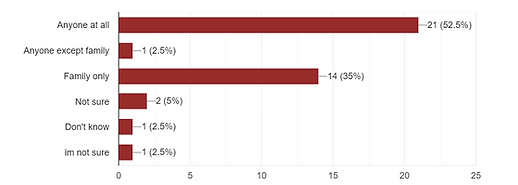
Figure 16
As can be seen from Figure 16, more respondents answered this seventh question correctly compared to the sixth question in this section. 21 respondents (52.5%) answered correctly that anyone at all can receive property from a Will (Wasiyyah) for Non-Muslims. 15 respondents on the other hand answered the question incorrectly with the answers of the person who can receive property from a Will (Wasiyyah) for Non-Muslims is anyone except family (2.5%) and family only (35%). The remaining 4 respondents (10%) were either unsure or did not know who could receive property from a Will (Wasiyyah) for a Non-Muslim.
Conclusion
In conclusion, it can be seen that interesting data was collected from the 40 respondents from UiTM Perlis, Arau Campus. Through the analysis made, it has been shown that most of the respondents were students and Muslims. However, there was a number of diversity as to the type of respondents that answered our firms survey. From this survey, we also identified that the topic of Wills (Wasiyyah) is not a widely known topic in the targeted community for our SULAM project. Although there were a number of respondents that has substantial knowledge in the subject matter, most respondents were not able to answer the basic questions pertaining to Wills (Wasiyyah) correctly as could be seen from the analysis of Section C. Most respondents also responded positively as to proposal to learn about Wills (Wasiyyah) as shown in Section B. Hence with this, it can be seen that with our target audience, our firm would proceed to conduct our SULAM project focusing on the basic elements of a valid Will (Wasiyyah) and its execution.